Field Notes, 4
A recipe for my Mother

Potatoes, Thinly Veiled
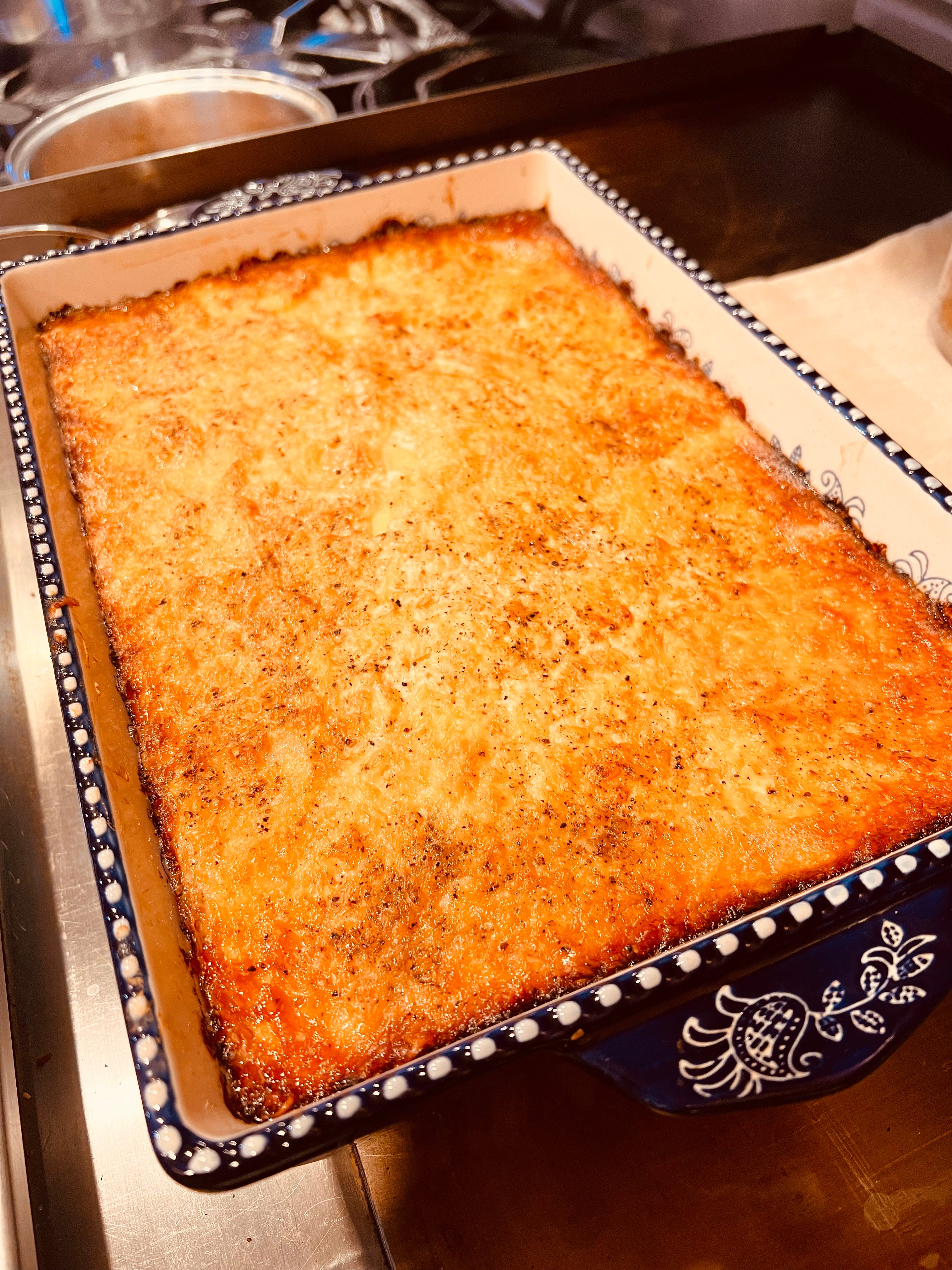
When I was a kid, these potatoes were a no. Not the hard no that closes a conversation. More the kind you say while already reaching for a second helping, because really—cheese and potatoes are the original bad idea you can’t quit.
The potatoes were architecturally thick. The result was a casserole that managed to be both burned and raw. The sauce was called cream-based though it was actually a gravy. Someone—usually my mother—might call it béchamel. The way some people might refer to their backyard as a garden. In our house, it meant: “Don’t criticize this, we’re doing our best.” They came out of the oven in a Pyrex dish—edges burnt in every possible decade, corners permanently etched with ghost casseroles of Christmas past.
At some point, the recipe evolved. Food Network’s idea, allegedly. Around here, direct advice was dangerous ground. Mom was likely to slip it through a neutral channel: “I saw this thing on TV where the chef par-boiled the potatoes for a minute before slicing them into the casserole.” A Geneva Convention. Food Network meant “I love our home too much to say this is your fault.” It was easier to let Rachael Ray shoulder the blame than risk bruising anyone’s testimony.
To be fair, parboiling helped. The potatoes softened a little, even approached edible. I remember really enjoying them that Sunday. But dinner was still dinner. There were worse fates than underdone potatoes. There was zucchini in “red sauce,” a dish that should’ve been tried at The Hague. The soupy, thin liquid was mostly zucchini runoff—vaguely tomato-flavored water that even the cheese couldn’t redeem.
We sat at the kids bar counter like refugees, speaking only in whispers. Waiting for divine intervention in the form of Dad, or dessert. The adults stood their ground for a while, insisting we eat at least half. But there are limits to endurance. Eventually one of them would sigh and say, “Fine, just eat the bread.” Which, of course, we already had.
Perhaps this is where my theology of food begins. Salvation in the form of butter. Love can be overcooked and under-seasoned, and you have to sit there and take it. Butter redeems it. The gift part of love. I eat good food now like I’m preparing for the end times. More vigilance than gluttony, right?
These days, when I make au gratin potatoes, I start slow. The kitchen’s quiet except for the hum of the refrigerator and the soft sigh of the oven as it begins to believe in itself. I always start with quiet first—cream sitting on the counter. Then I put on a little music. Chet Baker will give you a happier dish—something Ina Garten might serve Jeffrey on a Sunday in her smug little garden. But if you’re after potatoes that feed your soul and not just your family, go with Miles Davis. The notes bend air like steam—a little moody, a little blue, a little forgiveness at the right temperature.
I use a vegetable peeler now. I used to use a mandoline until it decided to harvest me. Took a small piece of my finger and a large portion of my confidence. The mandoline still lives here—way in the back of the cupboard, next to my waffle iron that comes out during periods of emotional compromise, dark times when we have “breakfast for dinner.” Oh—I got rid of the waffle iron. But I can’t throw out the mandolin. We paid too much for it, and also it knows something about me.
The peeler is slower, more tedious. I shave right past the skins and into the flesh until the potato itself is peeled, chip thin. The shavings fall into the bowl like pages from a diary, translucent and honest, curling in on themselves the way people do when they’re embarrassed.
“Au gratin” sounds fancier than it is. In French, it just means with a crust—anything topped with breadcrumbs, cheese, or both, and baked until the top browns. Technically, to be truly au gratin, there should be a shallow dish, a hot oven, and enough dairy to qualify as a moral dilemma. The French, of course, keep it tidy: cream, Gruyère, restraint. But over time, Americans have taken “au gratin” as permission to drown anything starchy in whatever’s in the fridge and call it comfort food. My version lives somewhere between gratin dauphinois and civil disobedience—no roux, no breadcrumbs, no apologies. By French standards, it’s probably a misdemeanor. By mine, it’s dinner.
There’s no flour. Just cream—the heavy kind that lists cow as its only ingredient. The label says 40% fat, which is a startling level of self-acceptance. Imagine if we all walked around with our BMI printed on us—and the higher the number, the higher the quality. I get gooseflesh just thinking about it. Pour the cream into a small-spout pitcher and stir in two spoonfuls of horseradish—Cordon’s, always Cordon’s. It’s the one part of the process where my elitism can safely stretch its legs. I’d sooner chew a raw potato and call it performance art than settle for a generic-brand horseradish that doesn’t live in the fridge section.
I add salt, kosher does fine, and pepper—grind until my wrist starts to ache. If it doesn’t smell faintly dangerous, something’s wrong. Cooking, like faith, should involve at least a small risk.
The recipe calls for Gruyère and Parmesan, but I’ve drifted toward what I call cheese à la surprise—whatever pale thing survived the week in the drawer. White cheddar. Swiss. Occasionally something wrapped in foil with no memory. Brie? Maybe. The French may have invented this dish, but they also invented colonialism, so I’m taking some liberties. One rule: absolutely nothing orange. Someone once tried to convince me Gouda was orange. That friendship didn’t last.
The layering is the quiet part of the prayer—the “pray always without ceasing” part. A pour of cream, a patient line of potatoes, a scatter of cheese. Press gently. Repeat. Salt every other layer like a gambler hedging bets. Crack pepper on every one. It’s tedious work, but that’s the point. Most real love is tedious. You do it because you said you would, not because you’re still enchanted—though every now and then, something bubbles up golden and surprises you into believing again.
We are a big, polygamous house, so the quantities shift depending on the day. Eight potatoes if everyone’s home, three or four cups of cream, a few cups of cheese—basically a family-sized act of contrition. If you’re lonely, cut it in half. Cooking for one isn’t for the faint of heart. It’s not sad, my mom would say, just quieter. Still, I’ve noticed she practices her version of “intermittent fasting” when no one’s around—like the food doesn’t make sense without an audience. Either way, the oven makes the same sound when you open it, a small rush of heat that says somebody’s here, even if it’s just you.
Baking time depends on temperature. Three twenty-five for an hour and fifteen, three-fifty for about an hour—those are the sweet spots. Go hotter and you’ll rush the softening; go cooler and you’ll lose faith halfway through. There’s a metaphor there, obviously, but I try not to get preachy while standing next to a hot appliance.
When it’s baking, I lean on the counter and watch the window fog with cream-scented steam. This is my favorite part. You can see patience happening in real time. Somewhere under all that dairy, the potatoes are surrendering. About forty minutes in, the smell changes, the house taking on an essence of hope—if hope were dairy-based and slightly flammable. The oven light makes everything look more competent than it is. I’ve learned to trust that illusion. There’s a comfort in believing that a little heat can make hard things soft and shapeless things golden. It’s the same reason people get married or buy rotisserie chickens.
While it bakes, I pretend to tidy up. I’ll rinse a spoon, wipe a counter, then stand there doing math about how much cream I’ve already used this month. I call this mindful cooking. The cream starts to hiss around the edges. That’s the sound of progress. Every few minutes I open the oven door, which of course makes the heat drop and adds another ten minutes to the process, but I can’t help myself. I’m not great at leaving things alone.
When the timer goes off, I take it out with the reverence I reserve for newborns and loan officers. It’s hot, bubbling, slightly threatening. A thin layer of fat floats on top, glistening so I can see my reflection on the surface. Every good or bad decision I’ve ever made reflects back at me right there in that glossy sheen. I blot it with a paper towel. You can’t stare into a puddle of butter and remain morally stable.
Let it rest fifteen to thirty minutes. I try, I really do, but every few minutes I circle back, fork in hand, just to “check the set.” There’s a metaphor in there somewhere about patience and timing. Perhaps we’ve already learned enough from these potatoes?
Serve them in the old transferware dish, the one with the blue flowers and the glued crack in the handle. Pyrex tastes like compromise. The transferware makes it look like we come from better people. When it’s ready, I scoop out the first portion and watch the clean edge it leaves behind. It’s strangely satisfying — a little geometry, a little grace. The potatoes slide onto the plate in slow motion, the top layers holding themselves together.
People make a big deal about food being love, but I think it’s more like evidence. You can see who we are in what we make: the ones who rush, the ones who hover, the ones who salt every layer because they don’t trust things will work out on their own. Sometimes, standing there with a fork, I get a flash of that kid sitting at the bar, chin in hand, staring down a plate of zucchini in red sauce and praying for deliverance. The kitchen’s quieter now, more mine, but it’s the same posture — waiting, hungry, trying to decide if I’ve softened enough to eat what’s in front of me.
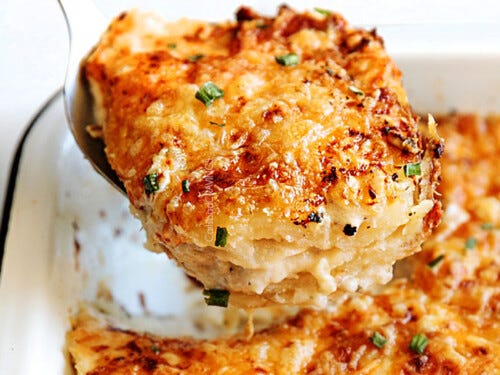
Potatoes au Gratin à la surprise
Ingredients
8 Yukon Gold potatoes, peeled paper-thin
3–4 cups heavy cream (40 percent or higher)
2 spoonfuls prepared horseradish (Cordon’s or nothing)
2–3 cups pale cheeses—Gruyère, Parmesan, white cheddar, Swiss, or cheese à la surprise
Salt and cracked pepper
Instructions
Preheat oven to 325 °F (for patience) or 350 °F (for hunger).
Mix cream, horseradish, salt, and pepper.
Layer cream, potatoes, cheese; salt every other layer.
Once the layering is complete, pour remaining cream over potatoes. Press gently, especially along the edges, to make sure there are no air pockets.
Top generously with cheese and cracked pepper.
Cover with foil; bake 1 hour 15 minutes (325 °F) or 1 hour (350 °F).
Uncover, raise to 375 °F, bake 15 minutes more until golden and slightly ashamed.
Blot the butterfat if self-awareness bothers you.
Let rest 15–30 minutes.
Serve in transferware—or at least tell yourself you would have, if life had gone differently.